
English version below ↓
Un anno dopo il lancio della America First Global Health Strategy, cominciamo a vedere con maggiore precisione che cosa significa applicare “America First” alla salute globale
Lo racconta un’inchiesta pubblicata il 18 settembre da Health Policy Watch. Il quadro che emerge non è semplicemente quello di una riduzione degli aiuti americani o di una diversa organizzazione dei finanziamenti. È la trasformazione della cooperazione sanitaria internazionale degli Stati Uniti in qualcosa di profondamente diverso: rapporti bilaterali governo-governo, progressivo disimpegno finanziario americano, pesanti obblighi di cofinanziamento per i paesi “beneficiari”, marginalizzazione della società civile e delle organizzazioni community-based, accesso privilegiato a dati sanitari e patogeni, intreccio sempre più esplicito fra assistenza sanitaria e interessi strategici ed economici degli Stati Uniti [1].
Trentacinque paesi hanno già firmato memorandum bilaterali con Washington. Secondo un’analisi di 18 di questi accordi citata da Health Policy Watch, il finanziamento americano destinato a quei paesi diminuirebbe complessivamente di oltre 2 miliardi di dollari entro il 2030, il 59% rispetto ai livelli del 2024. In Rwanda la riduzione prevista raggiungerebbe il 97%, in Liberia l’84%, in Burundi il 78%… chissà, forse non avevano molti tesori da offrire al Governo USA!
Per rispettare gli impegni assunti, il Malawi dovrebbe trovare ogni anno nuove risorse equivalenti al 56% della sua attuale spesa sanitaria complessiva. Alcuni accordi prevedono persino riduzioni automatiche del contributo americano se il paese non raggiunge il livello di cofinanziamento concordato 1.
Nel frattempo, oltre 3,6 miliardi di dollari già stanziati dal Congresso americano per la salute globale non sono stati erogati e PEPFAR risulta sotto-speso di circa 2,3 miliardi a causa dei ritardi nei pagamenti del Dipartimento di Stato. Non siamo quindi soltanto davanti alla necessità di fare i conti con meno risorse. Una parte delle risorse esiste, è stata autorizzata dal Congresso e non viene utilizzata 1.
Ma il punto che dovrebbe interessare particolarmente il movimento HIV è un altro.
Prima di Trump, ricorda Health Policy Watch, i programmi PEPFAR venivano definiti attraverso piani nazionali costruiti dai governi insieme alle organizzazioni della società civile. I nuovi memorandum sono invece accordi esclusivamente tra governi e non prevedono quel ruolo. Rischiano così di scomparire dai bilanci proprio quegli interlocutori indispensabili per raggiungere sex worker, MSM e altre popolazioni che i sistemi sanitari tradizionali spesso non raggiungono: Community health worker, peer educator e servizi community-based 1.
Non sta semplicemente cambiando l’architettura attraverso la quale arrivano i soldi. Sta cambiando chi decide, chi conta e, alla fine, chi viene raggiunto.
Non serviva aspettare un anno.
C’è una tentazione comprensibile, davanti a informazioni come queste: pensare che oggi sappiamo ciò che un anno fa, o anche soltanto due mesi fa, non potevamo sapere. Non è così.
Naturalmente non potevamo conoscere in anticipo l’entità esatta dei tagli, leggere memorandum che ancora non erano disponibili o misurare tutte le conseguenze della nuova politica americana.
Ma non serviva.
Nel luglio scorso sapevamo già che la sospensione degli aiuti americani aveva devastato una parte della risposta globale all’HIV. La stessa International AIDS Society, all’apertura della Conferenza mondiale AIDS 2026 di Rio, denunciava un crollo del 25% dei finanziamenti dei governi donatori nel 2025, attribuito interamente alla diminuzione del sostegno statunitense. La presidente IAS Beatriz Grinsztejn parlava di un momento di “real danger” per la risposta all’HIV e di persone vulnerabili che ne stavano già pagando il prezzo [2].
Soprattutto, il governo degli Stati Uniti non aveva mai nascosto la propria direzione politica, anzi l’aveva scritta nel nome: America First Global Health Strategy.
Le parole hanno un significato. America First applicato alla salute globale non descrive una cooperazione fra pari né una responsabilità condivisa di fronte a epidemie che, per definizione, non conoscono frontiere. Dice che l’intervento americano nella salute degli altri deve innanzitutto rispondere agli interessi americani.
Oggi abbiamo molte più prove delle conseguenze di quella scelta, ma per comprenderne la direzione politica non occorreva aspettarle.
Il palco di Rio.
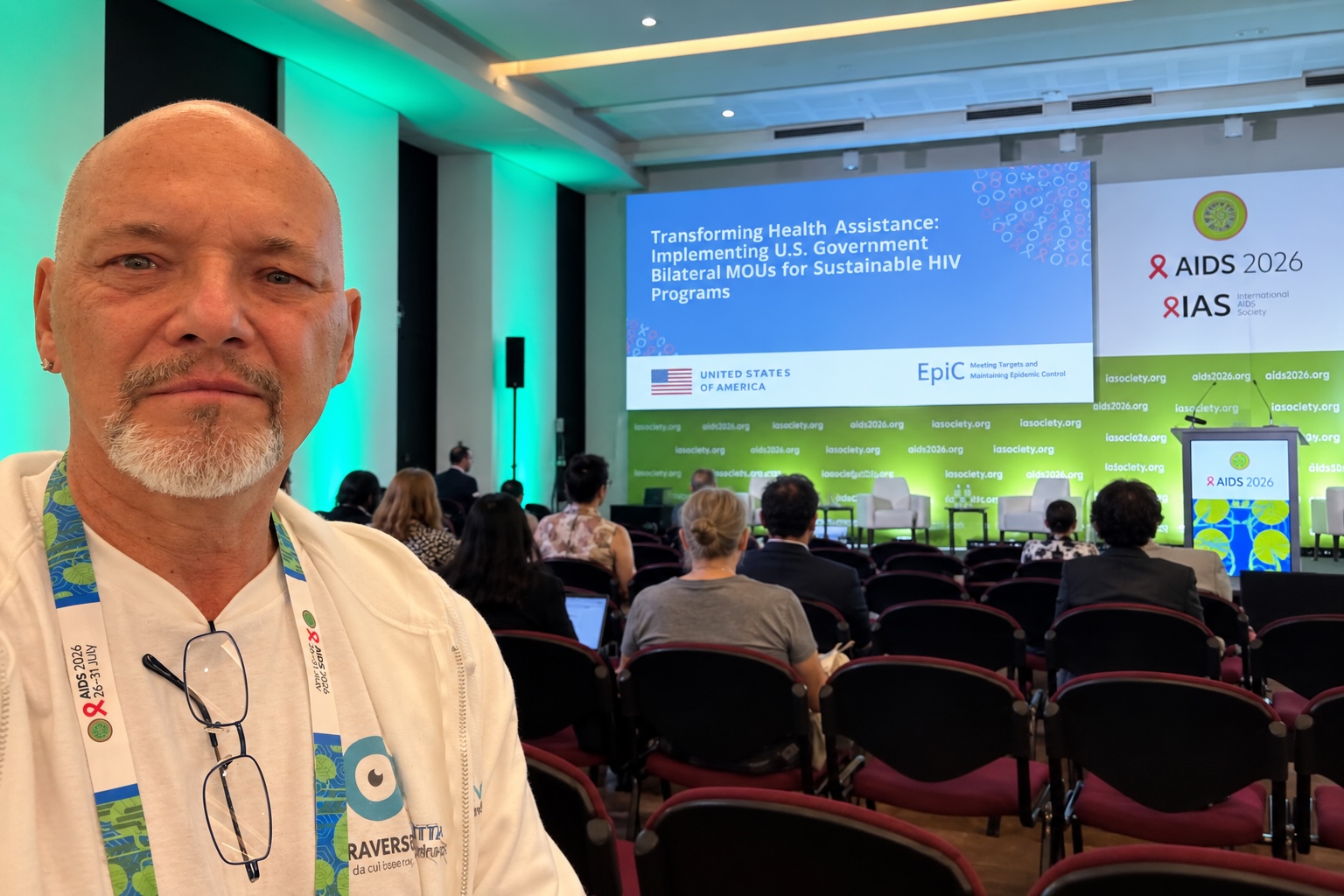
Il 26 luglio, alla vigilia dell’apertura ufficiale di AIDS 2026, il governo degli Stati Uniti disponeva di una pre-conference dedicata a Transforming health assistance: Implementing U.S. government MOUs for sustainable HIV programs.
Non era una sessione nella quale mettere a confronto la strategia americana con le organizzazioni che avevano perso finanziamenti e servizi, ma una presentazione della America First Global Health Strategy, dei memorandum bilaterali, dei piani di implementazione e delle relative strutture di governance.
La IAS non si limitò a tollerarne la presenza. Nel proprio Daily Digest invitava i partecipanti con una frase inequivocabile: “Hear from the US government itself”. La sessione era inserita nel programma della conferenza, promossa ai partecipanti e sostenuta dall’infrastruttura di AIDS 2026[3].
Le stesse regole stabilite dalla IAS per le pre-conference rendono difficile sostenere che si trattasse semplicemente di uno spazio esterno affittato da qualcuno.
Gli organizzatori dovevano sostenere o riflettere la visione e gli obiettivi della conferenza e rispettarne le politiche di diversità e inclusione. Soprattutto, la IAS si riservava esplicitamente il diritto di esaminare i contenuti e respingere una richiesta qualora l’organizzazione proponente non fosse in linea con i valori e gli obiettivi di AIDS 2026. La IAS forniva inoltre inserimento nel programma, promozione ai partecipanti, palco, attrezzature, supporto tecnico, streaming e registrazione [4].
Aveva quindi una scelta. Ha scelto di aprire quel palco.
Il prezzo della neutralità.
Prima della conferenza avevo posto pubblicamente una domanda: esistono limiti etici per la IAS?[5]
Insieme ad altri attivisti avevamo scritto alla presidente, all’Executive Director e al Governing Council chiedendo alla International AIDS Society di spiegare quali criteri etici giustificassero la concessione di una piattaforma istituzionale alla America First Global Health Strategy. La questione non era impedire al governo americano di esprimere le proprie politiche. Era capire perché la più importante conferenza mondiale sull’HIV dovesse offrire loro il proprio palco e il proprio prestigio istituzionale mentre quelle stesse politiche stavano già colpendo servizi e organizzazioni HIV.
La IAS non ha risposto alla lettera. La pre-conference si è svolta e a Rio la contraddizione è diventata quasi materialmente visibile. Durante la protesta contro le politiche americane, gli attivisti sono saliti proprio sul palco destinato alla presentazione del governo degli Stati Uniti. Alle loro spalle, una parete tappezzata dai loghi IAS, AIDS 2026 e iasociety.org incorniciava quello spazio e gli conferiva anche visivamente l’autorevolezza istituzionale della conferenza. Era difficile considerarla una presenza neutra o casuale: quella scenografia diceva, prima ancora delle parole, che l’America First Global Health Strategy veniva presentata dentro lo spazio ufficiale della più importante conferenza mondiale sull’HIV.
Quella fotografia oggi mi sembra raccontare molto più di una protesta.
Mentre le community contestavano una politica che stava togliendo loro risorse e spazio, l’istituzione che avrebbe dovuto rappresentare il luogo mondiale della scienza, dell’advocacy e della risposta all’HIV aveva dato a quella stessa politica il proprio palcoscenico.
Dalla partecipazione alla marginalizzazione.
L’inchiesta di Health Policy Watch rende oggi ancora più grave quella scelta, perché non documenta soltanto una riduzione dei finanziamenti, ma un cambiamento nei rapporti di potere: la società civile perde il ruolo che aveva nei processi PEPFAR, i servizi community-based vengono ridimensionati e gli accordi sanitari si intrecciano, in alcuni paesi, con interessi strategici e negoziati sulle risorse minerarie.
Questa non è country ownership. Trasferire improvvisamente costi enormi a paesi poveri, imponendo contemporaneamente condizioni definite dal governo americano, non significa restituire loro sovranità, così come sostituire la partecipazione della società civile con una trattativa tra governi non rende la risposta più sostenibile, ma sposta il potere proprio mentre molte associazioni HIV stanno cercando di sopravvivere a una delle più gravi crisi finanziarie degli ultimi decenni.
La responsabilità della IAS.
Non credo che oggi sia sufficiente che la IAS denunci le conseguenze di tutto questo. Già nel gennaio 2026 la stessa IAS sosteneva che la sospensione degli aiuti americani aveva ruptured traditional funding models, chiedeva partnership nelle quali la società civile potesse negoziare le condizioni degli aiuti e affermava che l’etica dovesse essere preservata “at all times in all settings”[6].
Una conferenza scientifica deve certamente consentire il confronto, anche con governi le cui politiche vengono duramente contestate. Ma a Rio non c’è stato alcun confronto. La pre-conference era uno spazio nel quale il governo degli Stati Uniti presentava la propria strategia, senza alcun contraddittorio e senza le community colpite da quelle politiche chiamate a discuterla sullo stesso palco. Il dissenso è arrivato dagli attivisti, attraverso la protesta.
Le parole, un anno dopo.
Health Policy Watch ci permette oggi di vedere con maggiore precisione dove sta andando l’America First Global Health Strategy. Una parte degli effetti è già visibile e la direzione politica non lascia più margini di ambiguità.
Oggi, di fronte alle conseguenze sempre più evidenti dell’America First Global Health Strategy, alla IAS non basta denunciarle come se osservasse dall’esterno un processo al quale è rimasta estranea. A Rio ha compiuto una scelta precisa e dovrebbe assumersene la responsabilità, perché l’accountability che giustamente chiediamo ai governi, alle aziende farmaceutiche e ai sistemi sanitari deve valere anche per le istituzioni della risposta globale all’HIV.
È anche da qui che passa la credibilità della leadership nell’HIV: dalla capacità di rispondere delle proprie scelte quando entrano in conflitto con le persone e le community che si dichiara di voler mettere al centro.
Ma la politica, per fortuna, non procede in una sola direzione: a New York Zohran Mamdani è diventato sindaco e a Berlino Elif Eralp ha portato Die Linke al primo posto, con la possibilità di diventare la prossima sindaca della città. Si comincia già a parlare di una “Mamdanizzazione”[7] della politica europea, segno che, pur trattandosi di vicende diverse, nessun paradigma politico è inevitabile.
Le fiammelle vanno tenute accese, soprattutto quando sembrano piccole. Perché mentre qualcuno prova a restringere la solidarietà al perimetro del proprio interesse nazionale, altrove continuano a emergere domande di diritti, giustizia sociale e responsabilità pubblica. Forse la speranza, oggi, sta anche qui: nel non accettare che America First diventi l’unico linguaggio possibile del futuro.
[1] Kerry Cullinan, “Controversy, Secrecy and Suffering after Year One of the America First Global Health Strategy”, Health Policy Watch, 18 settembre 2026. https://healthpolicy-watch.news/controversy-secrecy-and-suffering-after-year-one-of-the-america-first-global-health-strategy/
[2] International AIDS Society, “Funding for the global HIV response plunged in 2025, with devastating consequences”, 27 luglio 2026, IAS – Funding for the global HIV response plunged in 2025
[3] International AIDS Society, AIDS 2026 Daily Digest: Sunday, 26 July, IAS – Daily Digest, 26 luglio 2026
[4] International AIDS Society, “Book a pre-conference”, AIDS 2026, IAS – AIDS 2026, Book a pre-conference
[5] Sandro Mattioli, “America First alla Conferenza mondiale AIDS: esistono limiti etici per la IAS?”, Attraverso HIV, 17 luglio 2026, Articolo del 17 luglio 2026
[6] International AIDS Society, “Rethinking the HIV response”, Annual Letter 2026, 28 gennaio 2026, IAS – Annual Letter 2026
[7] Francesca De Benedetti, “La vittoria di Eralp a Berlino e la «mamdanizzazione» delle sinistre europee”, Domani, 21 settembre 2026; Imma Aguilar, “La ‘mamdanización’ de las campañas electorales”, Demócrata, 21 settembre 2026.
English version
America First, One Year On: The IAS’s Responsibility
One year after the launch of the America First Global Health Strategy, we are beginning to see more clearly what it means to apply “America First” to global health.
An investigation published by Health Policy Watch on 18 September tells the story. What emerges is not simply a reduction in US aid or a different way of organising funding. It is the transformation of US international health cooperation into something profoundly different: government-to-government bilateral agreements, a progressive US financial withdrawal, heavy co-financing obligations for “beneficiary” countries, the marginalisation of civil society and community-based organisations, privileged access to health and pathogen data, and an increasingly explicit intertwining of health assistance with US strategic and economic interests.¹
Thirty-five countries have already signed bilateral memoranda with Washington. According to an analysis of 18 of these agreements cited by Health Policy Watch, US funding to those countries would fall by more than USD 2 billion by 2030, a 59% reduction compared with 2024 levels. In Rwanda, the projected reduction reaches 97%; in Liberia, 84%; in Burundi, 78%… Who knows, perhaps they simply did not have many treasures to offer the US government.
To meet its commitments, Malawi would have to find new resources every year equivalent to 56% of its current total health expenditure. Some agreements even provide for automatic reductions in US contributions if a country fails to meet the agreed co-financing level.¹
Meanwhile, more than USD 3.6 billion already appropriated by the US Congress for global health has not been disbursed, while PEPFAR is approximately USD 2.3 billion underspent because of State Department payment delays. So this is not simply a matter of having to cope with fewer resources. Some of those resources exist, Congress has authorised them, and they are not being used.¹
But there is another point that should particularly concern the HIV movement.
Before Trump, Health Policy Watch recalls, PEPFAR programmes were developed through country plans drawn up by governments together with civil society organisations. The new memoranda are exclusively government-to-government agreements and provide no comparable role for civil society. Those most at risk of disappearing from the budgets are precisely the actors essential to reaching sex workers, MSM and other populations that conventional health systems often fail to reach: community health workers, peer educators and community-based services.¹
It is not simply the architecture through which money flows that is changing. It is who decides, who counts and, ultimately, who is reached.
We did not need to wait a year
There is an understandable temptation, faced with information like this, to think that today we know things that a year ago, or even just two months ago, we could not possibly have known. That is not true.
Of course, we could not know in advance the exact scale of the cuts, read memoranda that were not yet available or measure all the consequences of the new US policy.
But we did not need to.
By last July, we already knew that the suspension of US aid had devastated part of the global HIV response. At the opening of AIDS 2026 in Rio, the International AIDS Society itself reported a 25% collapse in donor-government funding in 2025, entirely attributable to the decline in US support. IAS President Beatriz Grinsztejn described it as a moment of “real danger” for the HIV response and said that vulnerable people were already paying the price.²
Above all, the US government had never hidden its political direction; it had written it into the name: America First Global Health Strategy.
Words have meaning. America First applied to global health does not describe cooperation among equals, nor a shared responsibility in the face of epidemics that, by definition, recognise no borders. It says that US involvement in the health of others must first serve American interests.
Today we have far more evidence of the consequences of that choice, but we did not need to wait for that evidence to understand its political direction.
The stage in Rio
On 26 July, the day before the official opening of AIDS 2026, the US government had a pre-conference entitled Transforming health assistance: Implementing U.S. government MOUs for sustainable HIV programs.
This was not a session in which the US strategy was confronted with the organisations that had lost funding and services. It was a presentation of the America First Global Health Strategy, the bilateral memoranda, implementation plans and governance structures.
The IAS did not merely tolerate its presence. In its own Daily Digest, it invited participants with an unmistakable phrase: “Hear from the US government itself.” The session was included in the conference programme, promoted to participants and supported by the AIDS 2026 infrastructure.³
The IAS’s own rules for pre-conferences make it difficult to argue that this was simply an external event for which someone had rented a room.
Organisers were required to support or reflect the vision and goals of the conference and comply with its diversity and inclusion policies. More importantly, the IAS explicitly reserved the right to review the content and reject an application if the proposing organisation was not considered to be in line with the values and objectives of AIDS 2026. The IAS also provided inclusion in the programme, promotion to participants, a stage, equipment, technical support, streaming and recording.⁴
It had a choice. It chose to open that stage.
The price of neutrality
Before the conference, I had publicly asked a question: are there ethical limits for the IAS?⁵
Together with other activists, we had written to the President, Executive Director and Governing Council asking the International AIDS Society to explain what ethical criteria justified granting an institutional platform to the America First Global Health Strategy. The issue was not to prevent the US government from expressing its policies. It was to understand why the world’s most important HIV conference should lend those policies its own stage and institutional prestige while those same policies were already hitting HIV services and organisations.
The IAS did not reply to the letter. The pre-conference went ahead, and in Rio the contradiction became almost physically visible.
During the protest against US policies, activists climbed onto the very stage intended for the US government presentation. Behind them, a wall covered with IAS, AIDS 2026 and iasociety.org logos framed that space and visually conferred upon it the institutional authority of the conference. It was difficult to regard that presence as neutral or accidental: even before a word was spoken, the setting itself said that the America First Global Health Strategy was being presented within the official space of the world’s most important HIV conference.
Today, that photograph seems to me to tell much more than the story of a protest.
While communities were contesting a policy that was taking resources and space away from them, the institution that should have represented the global home of HIV science, advocacy and response had given that same policy its stage.
From participation to marginalisation
The Health Policy Watch investigation makes that choice even more serious today, because it documents not only a reduction in funding but a shift in power: civil society is losing the role it had in PEPFAR processes, community-based services are being scaled back and, in some countries, health agreements are becoming intertwined with strategic interests and negotiations over mineral resources.
This is not country ownership. Suddenly transferring enormous costs to poor countries while simultaneously imposing conditions defined by the US government does not restore their sovereignty, just as replacing civil-society participation with negotiations between governments does not make the response more sustainable; it shifts power precisely when many HIV organisations are struggling to survive one of the most serious funding crises in decades.
The IAS’s responsibility
I do not believe it is enough today for the IAS simply to denounce the consequences of all this. As early as January 2026, the IAS itself wrote that the suspension of US aid had “ruptured traditional funding models”, called for partnerships in which civil society could negotiate the terms of aid, and stated that ethics had to be preserved “at all times in all settings”.⁶
A scientific conference must, of course, allow debate, even with governments whose policies are fiercely contested. But there was no debate in Rio. The pre-conference was a space in which the US government presented its own strategy, with no opposing voice and without the communities affected by those policies being invited to discuss it on the same stage. The dissent came from the activists, through protest.
The words, one year on
Health Policy Watch now allows us to see more clearly where the America First Global Health Strategy is heading. Some of its effects are already visible, and its political direction no longer leaves room for ambiguity.
Faced with the increasingly evident consequences of the America First Global Health Strategy, it is not enough for the IAS to denounce them as though it were observing from the outside a process to which it had remained entirely external. In Rio, it made a precise choice and should take responsibility for it, because the accountability we rightly demand from governments, pharmaceutical companies and health systems must also apply to the institutions of the global HIV response.
The credibility of leadership in HIV depends on this too: on the ability to answer for one’s choices when those choices come into conflict with the people and communities one claims to place at the centre.
But politics, fortunately, does not move in only one direction: Zohran Mamdani is now Mayor of New York, while in Berlin Elif Eralp has brought Die Linke to first place, with the possibility of becoming the city’s next Governing Mayor. There is already talk of a “Mamdanization” of European politics⁷, a sign that, different though these developments may be, no political paradigm is inevitable.
The little flames must be kept alive, especially when they seem small. Because while some are trying to confine solidarity within the perimeter of their own national interest, elsewhere demands for rights, social justice and public responsibility continue to emerge. Perhaps hope, today, lies here too: in refusing to accept that America First should become the only possible language of the future.
Notes
1. Kerry Cullinan, “Controversy, Secrecy and Suffering after Year One of the America First Global Health Strategy”, Health Policy Watch, 18 September 2026.
2. International AIDS Society, “Funding for the global HIV response plunged in 2025, with devastating consequences”, 27 July 2026.
3. International AIDS Society, AIDS 2026 Daily Digest: Sunday, 26 July.
4. International AIDS Society, “Book a pre-conference”, AIDS 2026.
5. Sandro Mattioli, “America First alla Conferenza mondiale AIDS: esistono limiti etici per la IAS?”, Attraverso HIV, 17 July 2026. An English version follows the Italian text.
6. International AIDS Society, “Rethinking the HIV response”, Annual Letter 2026, 28 January 2026.
7. Francesca De Benedetti, “La vittoria di Eralp a Berlino e la «mamdanizzazione» delle sinistre europee”, Domani, 21 September 2026; Imma Aguilar, “La ‘mamdanización’ de las campañas electorales”, Demócrata, 21 September 2026.